History
History
A History of School Karting
A History of School Karting

Our
History
In 1962 Jim McGregor (Northumberland) made the first school built “Kart” which led to interest from other Craft teachers.
Phil Darby , an advisor for craft education, met a pocket of keen teachers and developed a more organised and safer organisation.
Nothumberland's first “meeting” was at Bulmer airfield. Phil Darby and teachers set up Northumberland School Karting Association. Racing was not possible due to county insurance, so meetings were “Group Practices”.
By 1968 about 16 schools are involved in the Northumberland School Karting Association. In 1969 Phil Darby moves to Hertfordshire as Advisor to the Design and Technology subject. A group of keen teachers start to build karts. Herts Schools Karting Association is born and karting starts to be promoted as an extra curricular activity with help funded by Phil Darby and Herts Education.

In 1971, at Offley Place in Hertfordshire, teachers from Northumberland, Hampshire, Essex, Yorkshire, Lincolnshire and Hertfordshire met for a weekend “conference” and formed NatSKA.
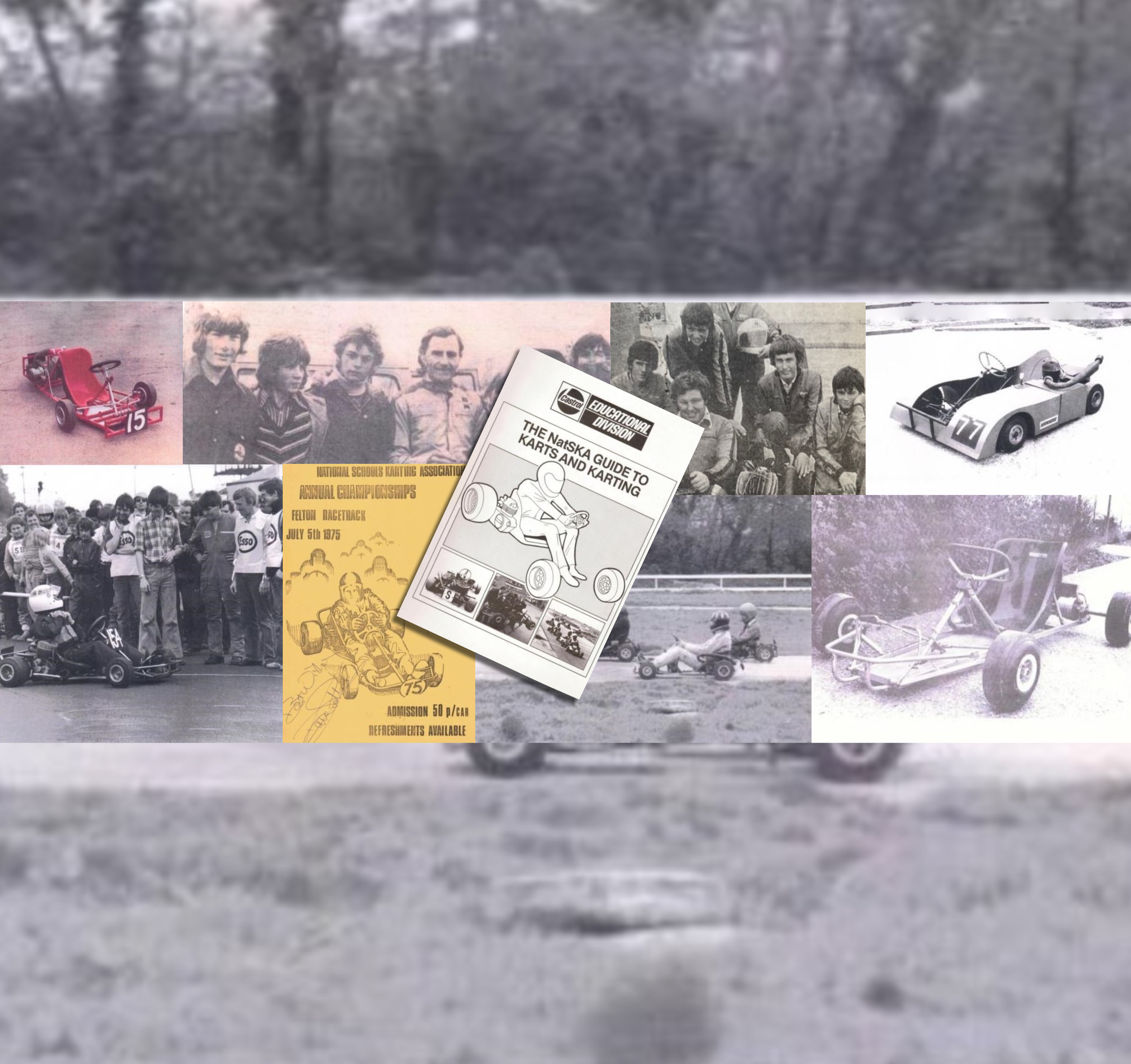
As popularity grew, race meetings became larger and the annual National Championship event became a “must do” meeting, with results being posted nationally. There were awards for best designed kart and best built kart which remained as prestigious trophies for many years.
Hertskart
Trikart
Kart building courses were organised to encourage schools to get involved. Schools could build a rolling chassis and be given an engine.
Experimentation in kart design was heavily encouraged leading to the design and building of karts such as the Hertskart, Plykart, Monokart, NatSKA 100, Nifty Fifty and Trikart. Some of these designs were made into plan books and spread throughout the country to encourage building.
Hertskart (pictured) – 1976 a rectangular tube chassis - 50cc ariel engine.
Plykart – Plywood flat chassis with square tube subframes - 100cc Stihl engine.
Monokart – Plykart with plywood monocoque upper body and steel subframes - 100cc Stihl engine.
Monokart 2 - Monocoque filled with expanding foam.
Natska 100 – 25mm round tube frame with minimum bends - 100cc Stihl engine.
Nifty Fifty – Aluminium central spine chassis with home made disc brakes using bicycle callipers. Very light weight - 50cc ariel engine.
Trikart (pictured) – 3 wheeled square tube chassis - 50cc ariel engine.
Many more “one offs” were designed and built by schools kart clubs, some successful and some not.
At Heronswood school in Hertfordshire, kart design and building was given a slot on the curriculum for students who were not destined for O levels. During a two year course, small groups of kids built and tested karts and then presented them to visiting examiners.
Engines used at this time were often taken from motorbikes with Yamaha FS1E 50cc, Honda H100 and Yamaha RS 100 cc (with the gearbox sawn off!) used along with Stihl 100cc and Solo 60cc chainsaw engines which became the backbone of NatSKA. The FS1E became popular as it could be used in 2 classes of racing, as a 4 speed gearbox and as a direct drive locked in gear.
Hertsfordshire grows to around 13 schools with race meetings at Rye House leading to annual Herts championships. Offshoots leading from karting included hovercraft building, off road motorbike building, bicycle design innovation and testing and motorised scooter building. All of which were presented as extra curricular competitions.
Interest from other counties leads to national spread of karting courses with lectures in training colleges. Loughborough summer school, Shoreditch College (now Brunel Uni) and other teacher training colleges had visits, presentations and practical driving sessions, as well as building workshops.
Videos are made on building karts in school, leading to the writing of The NatSKA Guide to Karts and Karting in 1984, written by Brian Lord (Breezehill School, Oldham), Colin Fenwick (Heronswood School, Herts) and Ian Paddy (Hull Grammar School) and supported by Castrol UK. This book was spread through schools and public libraries throughout the country.
At this time NatSKA ran 9 classes of racing based on engine type ranging from 50cc moped type, 50cc gearbox , 100cc low power, 100cc high power, 100cc rotary valve and 125cc gearbox.
Sponsorship interest from Castrol also lead to "Castrol Create a Kart", a national competition to design, build and race a school built kart. Held at Donnington and judged on criteria such as design innovation of whole kart and/or elements of a kart (braking systems etc), quality of craftsmanship and finish and track performance.
Other interesting developments happened during this time with a popular TV show at Rye House seeing Graham Hill Racing a NatSKA 100 against school drivers from Herts schools.
Magpie, a childrens Saturday morning programme featuring schools karts at Rye House.
Jackie Stewart drives a school kart around Rye House (very quickly!) and becomes NatSKA president!
Importantly NatSKA held a seat on the RAC kart committee for a number of years, giving the committee a perspective of “grass roots” karting (and making one or two deals with the trade representatives along the way!)
The public face of NatSKA is shown clearly in the National Sprint Championships (The Nationals).
From 1979 to 1988 the “Nationals” became sponsored by Esso leading to improved safety, organisation and overall presentation of the day, which was reflected in the huge entries. 1980 started the National Enduro Championship event which was held in the spring of each season.
To conclude our history, a few words from founding members Jim Hardy and Colin Fenwick from Barclay School. When interviewed for Motorsport UK's Revolution publication, they were asked:
What has been the most satisfying thing about your journey?
Jim: “The things I most remember are the kids’ faces. Even just now, we put out a young lad for the first time in our class 15 and he drove in, took off his race helmet and was grinning from ear to ear. That’s why we do it: smiles on faces.”
Colin: “I love it when kids who are not footballers, who are not sportsmen, join a kart team and suddenly become sportsmen - and very good ones. At the moment, our policy with Barclay over the last two years has been to recruit from years seven and eight, so we've got youngsters coming through the team. Results are irrelevant to us at the bottom end, it’s about getting the kids in the seats and on the circuit and improving, then the results will come.”